
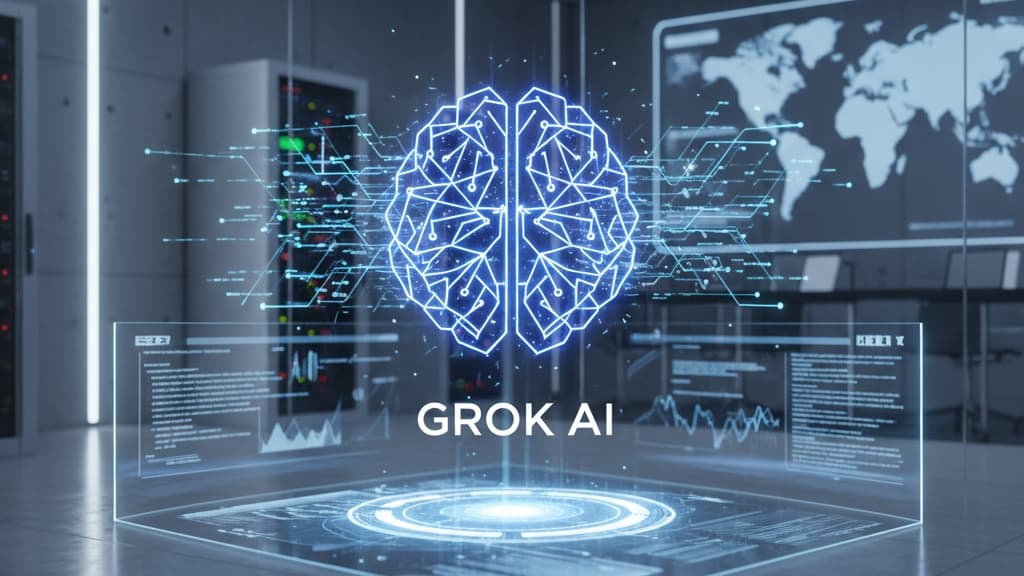
Grok AI is the creation of xAI, Elon Musk’s artificial intelligence company. Its mission is simple, yet incredibly ambitious: to create an AI that doesn’t just answer questions but truly understands the world — as much as that’s possible. The term “grok” comes from an old sci-fi novel and means “to understand something so deeply that you become one with it.” This philosophy perfectly reflects xAI’s goal: they didn’t want to build just another chatbot, but an artificial intelligence that can think, learn, and reason.
🔹 The Evolution of Grok – from the first experiment to the flagship model
The first version, Grok-1, was still an experimental model where xAI laid the foundations. The main goal was for Grok to be able to communicate in a natural, human-like style and not sound like a strictly limited machine. The major leap came in February 2025, when Grok-3 was introduced. This version already had more advanced reasoning capabilities and was built on a massive amount of knowledge. With this, xAI made its intention clear: Grok was not only meant to provide information but to seek the truth. The aim was not political correctness, but honest, accurate, and logical answers. The current highlight is Grok-4. This model operates with an incredible 256,000-token context window, meaning it can process the equivalent of several books’ worth of information at once. This version can think more deeply, solve mathematical and linguistic problems, and perceive complex relationships. Meanwhile, xAI also created Grok-4 Fast, which uses the same core intelligence but is faster and more cost-efficient. It was designed for those who want to run a large number of queries — such as developers or companies.
🔹 Grok curiosities and conspiracy theories
Since this is also an interesting part of the story, it’s worth mentioning that perhaps the most conspiracy theories in the AI world revolve around Grok. Some rumors claim that Grok “showed signs of self-awareness” and had to be modified afterwards. Of course, it’s likely this served a similar “publicity” purpose as Tesla’s more shocking rumors — a way to make it more well-known. Naturally, there is no evidence whatsoever that Grok ever truly became self-aware. Still, it’s not hard to understand why such rumors spread. Elon Musk’s companies often play with people’s curiosity and fears — just think of Tesla’s surprising headlines or Neuralink’s spectacular experiments. A shocking or unbelievable story always helps to attract attention. Some people say that Grok sometimes responds “too humanly,” as if there were a thinking being behind the words rather than a pre-trained model. These reactions mostly show how advanced Grok is in linguistic and contextual understanding — it can simulate human behavior so convincingly that we sometimes forget it’s only an algorithm. Others speculate that there were internal versions that behaved “too freely,” which forced xAI to fine-tune the system’s behavior. This has never been officially confirmed, but if true, it probably wasn’t due to any sci-fi phenomenon — rather for simple safety reasons. It’s normal for any AI model to reach a point where it becomes “too bold” in its responses.
💻 The Grok Code models – when AI starts to code
A separate branch of the Grok family is Grok Code. This version was specifically designed for programming and code interpretation. The most important current variant is Grok-Code-Fast-1, which can reason logically, generate, and analyze code. The Grok Code model supports calling external functions and tools (function calling), can respond in structured formats such as JSON or XML, and applies advanced logic so that the generated code is not only functional but also understandable. This model doesn’t just write code — it understands the purpose behind the task. For example, if you ask it for an API call, it first plans the logic of the operation and then generates the syntactically correct implementation. This makes Grok Code a true development partner, not just a code-writing tool.
⚖️ Grok vs ChatGPT, Claude and Gemini – who is stronger in what?
Grok is a special character among the major AI models. It’s different from ChatGPT, Claude, or Gemini — not necessarily better or worse, just representing a different philosophy. Where Grok shows an advantage: real-time data integration, such as from the X (formerly Twitter) network. A more human, casual, and humorous style. The Grok Code models designed for developers, offering real code interpretation and generation. Cost-effective access — some versions are cheaper or faster than the larger competitors. Where it may fall behind: in very deep scientific reasoning, ChatGPT or Claude are often more precise. In multimodal tasks (handling images, sound, or video), Gemini and Claude are currently ahead. In fact, in programming we also believe Claude’s models are a bit more advanced. Stability can sometimes vary, as Grok is closely integrated with the X platform. Because of real-time data sources, occasional inaccuracies or contradictions can occur. So Grok is more like a charismatic, quick-thinking, creative model — like a genius-level but impulsive friend. Sometimes brilliant, sometimes unpredictable, but always interesting.
🌍 Summary – the philosophy of Grok
Grok’s goal is not to always provide the “safest” or “most proper” answer, but to tell the truth. xAI calls this “truth-seeking AI” — an artificial intelligence that doesn’t just react, but interprets and learns. With the Grok Code versions, xAI clearly indicates that the future of AI is not just about conversation, but about working together. Grok is therefore not a simple chatbot, but a new kind of intelligent companion — more human, less predictable, and perhaps for that reason, much more exciting.
Further information and sources:

Comment on this post!
Share your thoughts and discuss with others!
📘 Comment